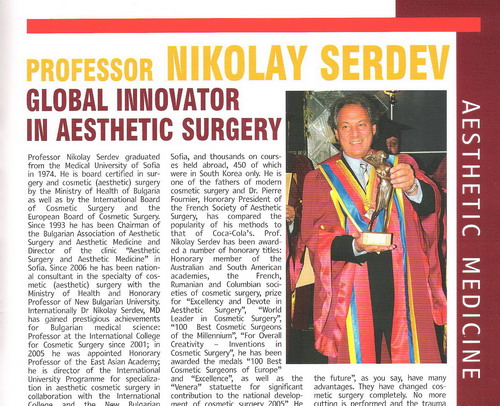
PROFESSOR NIKOLAY SERDEV GLOBAL INNOVATOR IN COSMETIC SURGERY
One World, 2 December 2008, 22:29
Professor Nikolay Serdev graduated from the Medical University of Sofia in 1974. He is board certified in surgery and cosmetic (aesthetic) surgery by the Ministry of Health of Bulgaria as well as by the International Board of Cosmetic Surgery and the European Board of Cosmetic Surgery. Since 1993 he has been Chairman of the Bulgarian Association of Aesthetic Surgery and Aesthetic Medicine and Director of the clinic "Aesthetic Surgery and Aesthetic Medicine" in Sofia. Since 2006 he has been national consultant in the specialty of cosmetic (aesthetic) surgery with the Ministry of Health and Honorary Professor of New Bulgarian University. Internationally Dr Nikolay Serdev, MD has gained prestigious achievements for Bulgarian medical science: Professor at the International College for Cosmetic Surgery since 2001; in 2005 he was appointed Honorary Professor of the East Asian Academy; he is director of the International University Programme for specialization in aesthetic cosmetic surgery in collaboration with the International College and the New Bulgarian University. He is a member of the editorial board of three international specialized scientific journals on cosmetic surgery and medicine, published in the USA, Spain and online. During the period 1998-2003 he was President of the Balkan Academy of Cosmetic Surgery and now he is the Chairman of its Board. He is a member of the Board of the International and the European Academy of Cosmetic Surgery. He is a member of the Board of Trustees and member of the International Examination Committee of the International Board of Cosmetic Surgery. Professor Serdev is the author of 21 methods, the so-called 'Scarless Serdev Suture Methods' for adding volume without implants, corrections, and liftings of all face areas, neck, breasts, abdomen and buttocks. He teaches, is a lecturer, and gives demonstrations on all continents. He has trained hundreds of foreign specialists following the Specialization Programme of "Cosmetic Surgery in
Sofia, and thousands on courses held abroad, 450 of which were in South Korea only. He is one of the fathers of modern cosmetic surgery and Dr. Pierre Foumier, Honorary President of the French Society of Aesthetic Surgery, has compared the popularity of his methods to that of Coca-Cola's. Prof. Nikolay Serdev has been awarded a number of honorary titles: Honorary member of the Australian and South American academies, the French, Rumanian and Columbian societies of cosmetic surgery, prize for "Excellency and Devote in Aesthetic Surgery", "World Leader in Cosmetic Surgery", "100 Best Cosmetic Surgeons of the Millennium", "For Overall Creativity - Inventions in Cosmetic Surgery", he has been awarded the medals "100 Best Cosmetic Surgeons of Europe" and "Excellence", as well as the "Venera" statuette for significant contribution to the national development of cosmetic surgery 2005". He is one of the founding members of the LIONS Club Sofia-Serdika. 1W: Your innovative method for aesthetic corrections was called the "Lifting of the Future". What does it actually consist of? These are 21 methods for lifting with special sutures, corrections to volumes, angles and proportions in all face areas, as well as particular areas of the body, lifting of breasts, buttocks etc. In fact, the innovative approach of these methods is that any of them is an answer to the issues and requests of the patients that want to undergo an operation, but without scars and being able to attend a meeting the same evening or to leave in a few days; who want that the change remains unnoticeable and to preserve the natural outlook of their beauty. Applying the old methods, which consisted of cutting facial skin, the face becomes like a mask, with "operated on" appearance and the natural outlook is lost forever. The new lifting procedures "of
the future", as you say, have many advantages. They have changed cosmetic surgery completely. No more cutting is performed and the trauma is minimal; incision points (needle perforations) to sew up major loose tissues to other stable tissues in a higher natural position are used, etc. The chance of bruising is minimal. If there is a swelling, it is so minimal that it is hardly noticeable by other people. Even when we work on various face areas, the patients frequently go out that same evening with close friends. The sutures are stable and we have performed the surgery in places that were hardly accessible with the old operation methods, because it is all done through perforation points in the skin. Previously the eyes' appearance didn't improve very much, but now we pay special attention to it and we can open the eyes, showing all their beauty by raising the eyebrows or by temporal lifting - upper lifting of the face that lifts it whole. There are many possibilities and combinations for every face. Buttock lifting did not exist before, but now it is a big hit in Asia, Latin America and all over. Of course, suitable cases have to be selected for each method. 1W: How much time and effort does this all take?
A number of years ago I was deputy director and, for a short period of time, director of the Burns Clinic of the Military Medical Academy. Despite my aesthetic nature (I like to paint, wanted to study architecture and have studied fundamentally the history of art) I found it difficult, at the beginning, to accept my patients' requirements to have no scarring and to be able to go on holiday immediately after the operation, or that their close friends or even boyfriend or husband shouldn't notice the change etc. At that time there were no such beautification methods. Surgeons just made incisions from end to end without thinking. I would say that the most difficult thing was to fight inertia in the profession. I myself had to change my way of thinking by 180 degrees, i.e. to take the patients' viewpoint, to put myself in their place and to imagine how would I like to feel and what would I pay attention to. I began to use my own methods of scar less lifting sutures for the different body and face areas in 1994. I set my requirements for elasticity to all thread manufacturers because each part of the face and body moves and the suture can cut the tissue. I found that the only semi-elastic threads were those made of Bulgarian polyamide silk. They are the only ones that are reabsorbed in two years and exactly that quality makes them without analogue in the world. It took me a lot of time to improve my tools -special needle tools that had to be semi-elastic, with a tip and surface that prevents from cutting or harming when passing through the tissues, having the precise curve and length. Thus we created a full set of instruments, specific for any operation. 1W: What does it mean to be an innovator in aesthetic surgery? This is an internal desire to be on the patient's side and to satisfy its requirements, to understand aesthetics as an art, to set no barriers to your dreams and to follow them constantly.
1W: What is the future of aesthetic medicine and if your methods are so successful that the scalpel is superseded by the needle, what will come after the needle?
Dr. Pierre Fournier said that in aesthetics the needle has become superior to the scalpel, i.e. surgery is not all about cutting and suturing. Needles will hardly lose their impor-
tance, since without them we cannot make tissue sutures. But we have to do everything possible to reduce incisions, especially skin cutting. Pierre Fournier again proclaimed an understanding in our circles that one centimetre of scar is equal to one kilometre in the soul of the patient. Surgery is now aimed at reducing operational trauma. Minimal invasive surgery has appeared, such as endoscope surgery, but this is still quite traumatic with the separation of tissues, blood-stopping and so on, which are typical methods for the open surgery. Needle methods such as lifting sutures are micro-invasive; they represent a close surgery in topographic anatomical levels that needs a lot of knowledge. There is no incision, no bleeding or skin wounds. Requirements to reduce trauma have led to injection methods and to the invention of devices for introducing medications through the skin without using needles. However, these are at their initial stage of development and they are not so effective so far. 1W: Bulgaria and the attitude to aesthetic surgery - from something completely unknown for most of the people in the past to the TV show. How did Bulgaria change that way? I think that every country has its contribution to history and to medicine. However, today it is much easier to work in Bulgaria and to be known from Asia to America. Internet has united the world in a single society. At the end of the 20th century I realized that I was much more famous in Asia and Latin America than in Bulgaria. The reason for that, in addition to the immediate effect and the short post.-operative period is the skin those ethnic groups have, that is liable to ugly formations known as kelloids - this is the uncontrollable swelling and growth of scars from skin incisions. Therefore my methods without skin cuts proved invaluable for aesthetic surgery in that part of the world. When in 2000 I was honoured in Australia, I couldn't believe that they had seen my films there, that they had read my publications and knew everything about me. And now when I teach abroad, my colleagues take out their laptops, play one of my lectures or videos from the Internet and ask specific questions. Today we are like a family and information reaches us in seconds. Travelling is different than before. Planes, ease of travel in hours from one continent to another makes it easier to communicate and to get to know each other. 1W: What are the world trends and
the professional level of Bulgarian physicians?
We have already spoken that in the global community nothing belongs to a single nation anymore. Thinking has to be international, since nations and ethnic groups have mixed. Professionalism and the methods which we have developed have to be internationally applicable and many Bulgarian physicians have proved themselves around the world precisely with these qualities and on the basis of their individuality. 1W: You teach, give lectures and demonstrations in all continents, you meet many people. How do you relax, and what is that we don't know about Dr. Serdev outside the clinic and operation room? When I was young I was an athlete and participated in swimming, surfing, skiing and snowboarding competitions. Now, when I'm not busy, I like to be outdoors and practice these sports. The great thing is that they cover all seasons. When I was a student at the German Language High School, I worked as an interpreter and this helps me now to give lectures in German. It is the same with the Russian language when I give lectures in Moscow and with the English language internationally. 1W: Do you think that your profession is a challenge to Mature? Has there been a moment to say that there is nothing stronger than Nature?
Don't ever doubt it - Nature is above all of us. However, however much we change our patients, they remain subject to the laws of nature, and although we can turn the clock back, we cannot stop the march of time. 1W: What have these 15 years meant for the Medical Centre you are running?
The clinic has been accredited by the Ministry of Health as the only centre for specialization in cosmetic (aesthetic) surgery and we were appointed four interns during this year. We have an accreditation of the International College of Cosmetic Surgery too, as one of the ten international centres of post-graduate training and specialization in cosmetic surgery. 1W: Why do you always come back to Bulgaria? With your profession, fame and abilities, you could be anywhere in the world. That's exactly what I do - I work, I teach in various places around the world, but here is where my duties are. I like to be introduced as a Bulgarian.
By Daniela Yakova